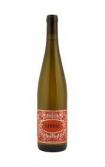
German wine labels are getting more light-hearted. They used sport bucolic images of half-timber villages and spooky castles. Today's young winemakers are less likely to be descended from wine dynasties or attached to such... Read More
Known as Gutedel (goot-EH-del) in Germany, Fendant in Switzerland, and Chasselas in France, this grape is a specialty in the Baden region of southwest Germany, specifically Markgräflerland, bordering Alsace and Switzerland.... Read More
From an historical plot named on the little wood, Auf Dem Holzchen is dry, piercing, and stony with touches of sage and green apples. There is a very slight touch of residual sugar for balance, but this tastes drier than the 10%... Read More
Dry and dense, from 50-60 year-old late-harvested vines, Altenberg AP-7 shows slate and ripe malic fruit with rounded acids. At 11.5% ABV, you can enjoy this spätlese with roast chicken, pork, boar, or game birds.... Read More
If you're buying something special for someone special who loves Riesling, get old-vine (alte-reben) Gisela. 2023 is floral, seductive, aromatic, lithe, yet loaded with sour candy. You don't want to obscure the lively... Read More
Gisela 2024 is just such a lovely and crushable Riesling with ripe stone fruit, a little bay leaf, bread notes, and spiky acidity. This would be great with elegant Cantonese dishes or perhaps milder Korma-style curries. Off-Dry... Read More
Perhaps one of the most difficult to pronounce, iron-rich Krettnacher Euchariusberg (oy-ka-ree-yoos-bear-g) delivers some of the most zingy wines. Kugel Peter is delicious and easy-drinking with citrus, stones, minerals, salts,... Read More
2024 Kugel Peter is quite different than 2023. This savory version of AP-12 shows notes of pastry, pears, peach, and hints of dill. The ultimate accompaniment would be hearty German rye bread, Tillamook or Ben's Cream Cheese,... Read More
Mammen is becoming more interesting over time. It's worth noting that Rieslings age amazingly well: as the sugar and acids increase, so does aging ability. It would be wonderful to taste this AP-24 in 2032, but who has that... Read More
Klaus is vinified from riper fruit, and it shows through its complexity and weight. However, AP-6 remains lively with notes of roses, linden, herb tea, mint, and assorted stone fruit. Try this Riesling with soft Gorgonzola, Brie,... Read More
Of the three Feinherb parcels within Niedermenniger Herrenberg, Palm is the most slate-driven with touches of lime, fennel, and a nice balance of residual sugar. Feinherb is another name for Halb-Trocken (half-dry), an even more... Read More
Onkel Peter AP-4 is also a Feinherb from Niedermenniger Herrenberg, but even from the same vintage and vineyard, AP-4 is so different from Palm. Expect dried straw, petrol, lemon curd, and some sweet red berries. We would love... Read More
The handsome label doesn't tell you much. In fact, 1000L makes no sense to most people, so let's start there. It refers to the smallish 1000 liter (264 gallon) fass or fuder, a traditional barrel used in the Mosel, where... Read More
We don't see many wines from Germany's mid-region centered around Würzburg, near the Bavarian border. Franken is famous for its Silvaner and is one of two regions allowed to use the flat Bocksbeutel (goat scrotum)... Read More
Julian Ludes (lood-ess) refers to his steel-vinified Riesling from the flatlands of Thörnicher Schiesslay as a breakfast wine, likely due to its low ABV of 9%. In New York, we would pair it with a nice brunch closer to 10am... Read More
A bit more common in Germany than here, Blanc de Noir is a unique take on Pinot Noir. Hammelmannn makes his wine in a corner of Pfalz, where the distinct soil is suited for the region's most important crops, Grumbeer und Zwiebel... Read More
Müller-Ruprecht produces wine in the Pfälzer village of Kallstadt, approximately 20 km west of Heidelberg. This is where Philipp & Sabine Wöhrwag make some really cool chemical-free wines like a Dornfelder Pet-Nat,... Read More
We're big fans of Peter Lauer, from whom we feature a dry Riesling, off-dry Riesling, and now a dry Sekt (pronounced z-eh-kt). Although Germany is not well known for sparkling wine, it makes and consumes significant amounts.... Read More
Fass #8 is a luxurious Riesling from the village of Ayl (eye-l), about an hour's drive east of Luxembourg. Although the region is often lumped together as Mosel-Saar-Ruwer, we prefer using the individual river designation... Read More
Perhaps it is a surprise that Pinot Noir (aka Spätburgunder) is the most planted red grape in Germany and also accounts for some increasingly lovely pink wines. Florian Fauth is blessed with limestone-rich soils located south... Read More